Professional Resources

horse with sunrise

The latest guidelines

Veterinary professionals are a trusted professional voice in the context of sustainable parasite control.   Historically, our response to clients asking about deworming might have been simply to guide which dewormer was chosen.  However, it is crucially important in this era of increasing dewormer resistance and overt clinical disease, to take the lead on encouraging excellence in parasite control. 

There are numerous resources and guidance for vets and their clients published in the past couple of years, which summarise evidence, and encourage more responsible dewormer prescribing practices, with equal importance placed on advising our horse owners to take steps to reduce their need for dewormers such as improving pasture management, stocking density and poo-picking.  Blanket (so-called interval) deworming is no longer recommended, since it accelerates resistance to dewormer medicines.

Using affordable, widely available testing such as faecal egg counts (FEC) should also be encouraged to highlight which horses are shedding the greatest number of eggs onto pasture.  Where possible, a once yearly FEC reduction test (FECRT) is recommended to keep track of dewormer activity so that, on a particular premises, the efficacy of the active drug in a dewormer is known.

What this means in practice is that when a client asks for a dewormer, rather than just dispensing a 'routine' treatment, we should ask a few quick questions to understand the risk for their horse(s) and then recommend appropriate testing. 

Read the latest guidelines
CANTER logo

Eqvalan®

Eqvalan®: A dewormer paste containing the active ingredient ivermectin.  

An appropriate choice for high FECs in the grazing season and for annual deworming of low-risk horses who have not been dewormed all year. 

Eqvalan® is licensed for the treatment of these parasites in horses and donkeys:

  • Small strongyles (Redworm, Cyathostomes)- adults and L4 larvae
  • Large strongyles (Redworm)- including arterial larval stages of S vulgaris
  • Roundworms (Paracaris equorum, Ascarids)- adults and larvae including tissue stages
  • Lungworm (Dictyocaulus arnfieldi)- adult and immature
  • Pinworm (Oxyuris equi)- adult and immature
  • Threadworm (Strongyloides westeri)
  • Hairworm (Trichostrongylus axei)
  • Large-mouth stomach worms (Harbronema muscae)
  • Neck threadworms (Onchocerca spp)- microfilariae
  • Bots (Gasterophilus spp)- oral and gastric stages 

After a risk assessment, and with diagnostic tests to confirm disease, ivermectin may be advised for infections with any of the target species above.

For Parascaris and Cyathostomes, resistance is reported, but the patterns of resistance are not predictable and so it is advisable to check a FECRT once a year after treatment, in order to establish the resistance pattern on the individual property.

Learn More
Eqvalan packaging

Eqvalan Duo®

Eqvalan Duo®: A dewormer paste containing the active ingredients ivermectin and praziquantel.  

An appropriate choice for tapeworm treatment or for annual deworming of low-risk horses who have not been dewormed all year.

Eqvalan Duo® is licensed for the treatment of these parasites in horses- as for Eqvalan® with the addition of cestodes (tapeworm):

  • Adult tapeworms (Anoplocephala perfoliata, Anoplocephala magna)
  • Small strongyles (Redworm, Cyathostomes)- adults and L4 larvae
  • Large strongyles (Redworm)- including arterial larval stages of S vulgaris
  • Roundworms (Paracaris equorum, Ascarids)- adults and larvae including tissue stages
  • Lungworm (Dictyocaulus arnfieldi)- adult and immature
  • Pinworm (Oxyuris equi)- adult and immature
  • Threadworm (Strongyloides westeri)
  • Hairworm (Trichostrongylus axei)
  • Large-mouth stomach worms (Harbronema muscae)
  • Neck threadworms (Onchocerca spp)- microfilariae
  • Bots (Gasterophilus spp)- oral and gastric stages 


In general it is assumed that tapeworm transmission will diminish in the winter months, due to the cold weather’s impact on the intermediate host (oribatid mite).  For this reason, if a tapeworm treatment is required, it is most ideal to administer the dewormer at this time, however, urgency of treatment may be important in individual circumstances, in which case treatment should be given when needed, regardless of the time of year.

After a risk assessment, and with diagnostic tests where appropriate to confirm infection, this praziquantel and ivermectin product may be advised for infections with any of the target species above.

For Parascaris and Cyathostomes, resistance is reported, but the patterns of resistance are not predictable. Resistance to praziquantel in tapeworms is reported, but in general the active ingredient remains highly effective for the control of tapeworm

For this reason, it is advisable to check a FECRT once a year after treatment, in order to establish the resistance pattern on the individual property.

Learn More
Eqvalan Duo packaging

What dewormer(s) should I include in a worm control plan?

Strongyle (redworm) treatment:

For those horses that need deworming during the grazing season (based on FEC), ivermectin (eg Eqvalan®) or pyrantel are usually the most appropriate choice. Due to widespread resistance, fenbendazole should only be used for redworm treatment if you know that it is still effective on the premises (eg based on FECRT tests)1.


For treatment of encysted redworm in winter/early spring, only moxidectin and fenbendazole (5 day course) are licensed. Due to resistance to fenbendazole, in many cases moxidectin is the only effective product. It may therefore be prudent to reserve moxidectin for only the treatment of encysted redworm, to preserve its efficacy for when it is really needed.

horse head

Parascaris equorum (roundworm) treatment:

In contrast to strongyles, macrocyclic lactone resistance appears to be widespread in Parascaris while fenbendazole and pyrantel remain effective, and are therefore a good choice for roundworm treatment of youngstock1.


Tapeworm treatment:

Tapeworm can be treated with either praziquantel (available in combination products such as Eqvalan Duo®) or a double dose of pyrantel so it is a good idea to co-ordinate tapeworm testing with a FEC so treatment can be given for both if required.

girl and pony

You can choose Eqvalan® and Eqvalan Duo® as part of targeted control against equine parasites

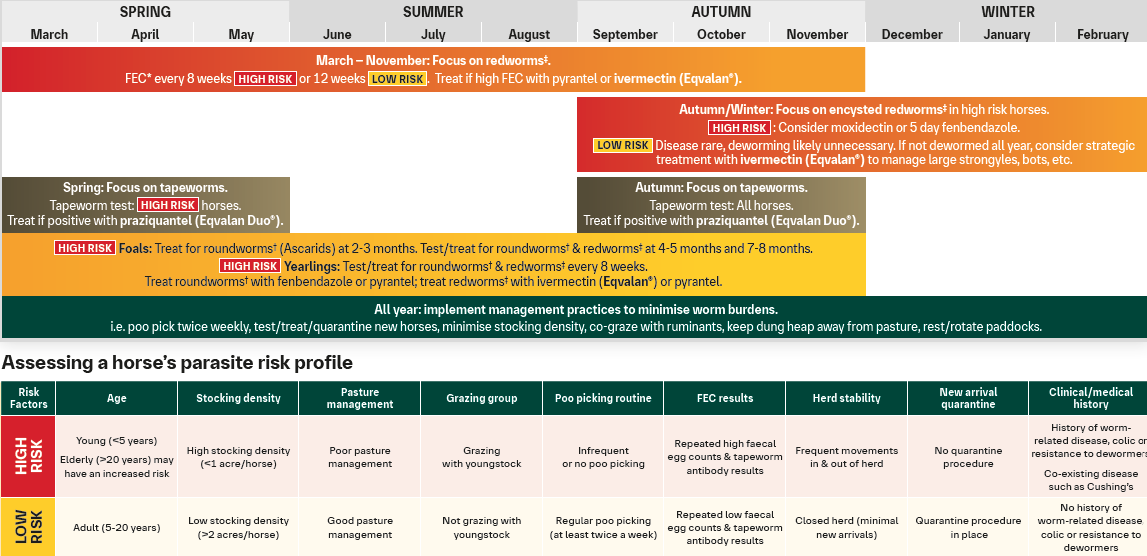
Download your Smartworming Schedule
Smartworming schedule

Further Information

Eqvalan® Oral Paste for Horses contains Ivermectin. UK: POM-VPS; Eqvalan Duo® Oral Paste contains Ivermectin and Praziquantel. UK: POM-VPS. Further information available in the SPC or from Boehringer Ingelheim Animal Health UK Ltd., RG12 8YS, UK. UK Tel: 01344 746960 (sales) or 01344 746957 (technical). Email: vetenquiries@boehringer-ingelheim.com. Eqvalan® and Eqvalan Duo® are registered trademark of Boehringer Ingelheim Animal Health France SCS, used under licence. ©2025 Boehringer Ingelheim Animal Health UK Ltd. All rights reserved. Date of preparation: Oct 2025. UI-EQU-0147-2025. Use Medicines Responsibly.

Prescription decisions are for the person issuing the prescription alone.